
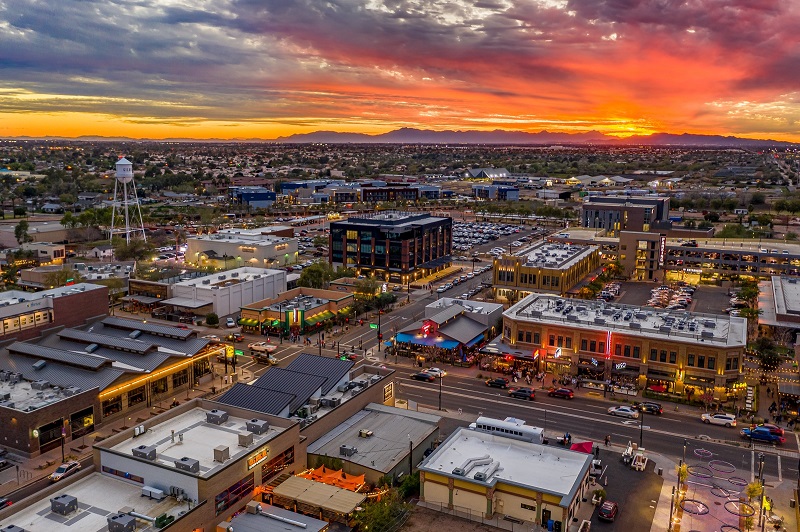
Queen Creek backyards are either big or brand new, and sometimes both. On rural estate lots, a patio can be as large as you like, so the real question is how big is right. In the new subdivisions, the patio is often the first real hardscape the yard gets. Either way we plan the grade first, because flat former farm ground doesn't drain itself.
What a paver patio costs on a Queen Creek property
On a Queen Creek property, a concrete paver patio of about 300 to 600 square feet typically comes to $2,500 to $6,600 installed. The material is the biggest lever:
- Large format pavers: about $3,300 to $7,800
- Artistic pavers: about $4,200 to $9,600
- Natural stone or travertine: about $4,500 to $10,800
- Porcelain: about $5,700 to $13,200
Removing an old concrete patio adds about $750 to $1,800, and a hard-to-reach backyard adds about $150 to $300. The minimum job is $800. Patios on acre lots often go past 600 square feet, and their totals run past these ranges.
Here's a worked example. A new-build home in a Queen Creek subdivision has a narrow side gate, and the owner wants a natural stone patio. Natural stone runs $4,500 to $10,800, and the tight access adds $150 to $300, so the total is about $4,650 to $11,100. Measuring the space gives you the exact figure. For now, the estimator offers a ballpark.
Sizing a patio for a big lot
On an acre lot, it's easy to build too little or too much. A small patio looks lost in a big yard. Paving the whole back of the lot is expensive and leaves nowhere for water to go.
Start with what happens out there: a dining table, a grill, chairs around a fire, a spot in the afternoon shade. Size the patio for those, with room to walk around the furniture, then connect it to the pool, the garden or the shop with walkways instead of more patio. Large format pavers suit bigger spaces well. Fewer joints keep a wide patio from looking busy.
Lighting matters on a big patio, since summer evenings are when you'll use it most. Here's what makes a patio feel like a resort, lighting included.
Finishing a new-build backyard
Queen Creek grew from about 4,300 people in 2000 to nearly 60,000 in 2020, so a lot of yards here are only a few years old. Most new homes come with a small slab under the patio cover. You can pave around it or remove it for one continuous surface. If the slab is level and sound, keeping it saves the $750 to $1,800 removal cost, but the seam between concrete and pavers will always show.
If a pool is in your plans, build the pool first. Then the pool deck and patio can be designed and built together, in one paver family, with heights and borders that line up. If your subdivision has an HOA, its design review comes into play, and we confirm that and the Town of Queen Creek's rules before booking the install.
Grade and steps on flat ground
Most of Queen Creek sits on old farm fields, and a flat backyard holds water. The patio has to fall away from the house, gently enough that a table doesn't wobble but enough that monsoon rain runs off toward the yard.
New homes often sit a step or two above the yard. Where the patio meets the back door, the steps should all be the same height, with clean edges and no surprises. We work out elevations and drainage together before we dig, and this post covers keeping steps consistent while the water drains away. The patio itself goes in over a base compacted to firm, with a screeded sand bed, restraint along the edges, then the pavers, swept joint sand and one more compaction.
Paver Patios in Queen Creek: Frequently Asked Questions
What does a paver patio cost on a Queen Creek lot?
Most concrete paver patios of about 300 to 600 square feet run $2,500 to $6,600. Large format runs about $3,300 to $7,800, natural stone or travertine about $4,500 to $10,800, and porcelain about $5,700 to $13,200. Bigger patios on acre lots run past those ranges.
How big should a patio be on an acre lot?
Size it for what you'll do there: dining, grilling, a fire, shade. Then connect it to the rest of the property with walkways. That usually looks better and costs less than paving a huge area.
I'm planning a pool. Should the patio wait?
Usually, yes. Build the pool first, then design the pool deck and the patio together so the pavers, heights and borders line up. A concrete paver pool deck with coping typically runs $7,000 to $13,400.
Should I keep the builder slab under my patio cover?
If it's level and sound, you can pave around it and skip the $750 to $1,800 removal. If you want one seamless surface, it comes out.
Do you install large format pavers?
Yes. Large format patios typically run about $3,300 to $7,800 for 300 to 600 square feet. Fewer joints suit the wide, open patios that big Queen Creek lots allow.