Where Should Water Drain on a Paver Driveway?
May 3, 2026
Drainage isn't the most exciting part of a paver driveway, but it's one of the things that'll make or break the job. If water doesn't have a clear path to leave your property, it's going to find one, and usually that's right up against your foundation or pooling in the middle of your driveway. So before we ever lay a paver, we've got to be cognizant of where the water is going to go.
Water Always Wants to Move From Back to Front
The first thing we look at on any property is the natural slope. On most homes, water is obviously going to flow down toward the street, that's how the lot was graded when the house was built. Our job is to make sure that flow keeps going from the back of the property all the way to the front, and then out into the street or gutter system.
If we interrupt that flow with a flat section, or worse, a low spot, water sits. Sitting water on pavers leads to staining, joint sand washout, and over time, settlement. So every elevation we set has a purpose, keep the water moving in the direction it already wants to go.
Tying Into Existing Gutters and Hardscape
A lot of homes already have gutters and downspouts dumping water onto the driveway area. We don't fight that. We work with it. Once the water hits the pavers, we make sure the slope continues that flow and gets it away from the house.
That usually means:
- Pitching the field of pavers a small amount per foot toward the street
- Keeping borders and edge restraints from creating little dams
- Making sure transition points (driveway to walkway, walkway to patio) flow downhill, not into a corner
When it's done right, you shouldn't even notice the slope walking on it. But after a monsoon, the driveway should be drying out within a few minutes, not holding puddles.
Elevation Challenges Change the Plan
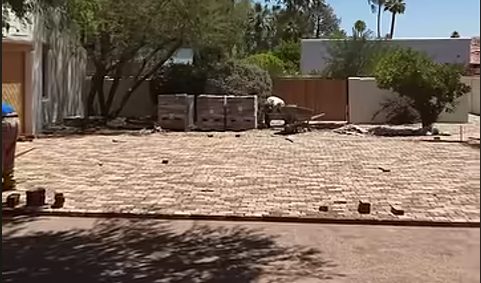
Not every property is straightforward. On a recent job we had a real puzzle, there was a concrete driveway with concrete steps that were all different heights, and over on the side it was just rock. The homeowners wanted a patio in the front, steps going up to the entrance, and another patio on the side.
Anytime you've got mixed elevations like that, the drainage plan has to be designed around them, not the other way around. We had to:
- Reset the steps so they were all consistent and didn't trap water on a tread
- Build the new patio at a height that fed water away from the entrance, not toward it
- Tie the side patio in so it drained to the same low point as the driveway
If we'd just matched the existing concrete heights, water would have ponded right at the front door. That's the kind of thing nobody thinks about until the first big rain.
What to Ask Your Contractor
If you're getting bids on a paver driveway, drainage is one of the questions worth asking up front. A good contractor will be able to tell you:
- Which direction the water is going to flow when they're done
- Where it ends up (street, gutter, drain, dry well)
- How they're handling any low spots or elevation changes
- Whether you need any extra drainage like a channel drain or French drain
If they don't have a clear answer, that's a red flag. Pavers laid without a drainage plan look great on day one and become a problem the first time it really pours.
If you want us to come out and look at how water moves on your property, that's part of every estimate we do. We'll walk it with you and explain exactly where it's going to go before we ever pick up a tool.
Curious what your project might cost?
Get an instant ballpark with our free estimator tool, no contact info required.