Clay Brick vs Concrete Pavers: What's the Difference?
June 27, 2026
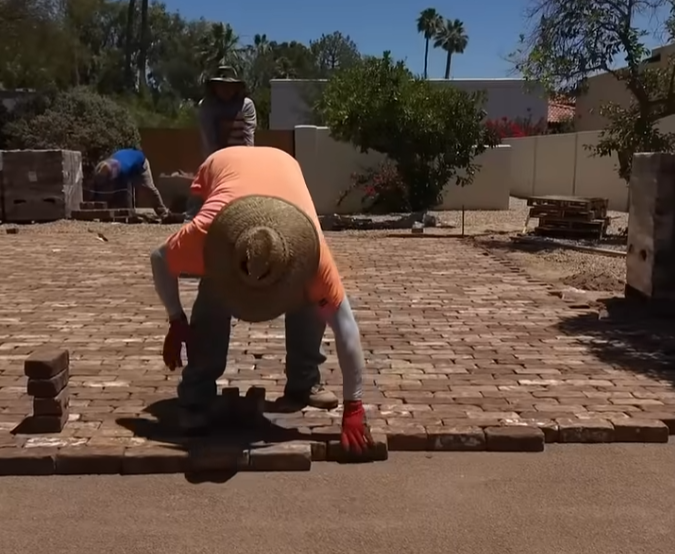
On this job we''re laying clay brick, not concrete. They both end up under your feet and they both lock together the same way once the sand goes in, but they''re two very different products. If you''re trying to decide between them for a driveway, patio, or walkway, here''s what actually matters.
What Clay Brick Actually Is
Clay brick is exactly what it sounds like. Natural clay, shaped, then fired in a kiln at high heat. That firing is what gives it the color. The color isn''t painted on or mixed into the surface, it''s baked all the way through the brick. That''s why a clay paver can sit out in the Arizona sun for 30 or 40 years and still look close to the day we put it down. It doesn''t fade the way a tinted concrete unit can.
Concrete pavers are a manufactured product. Cement, aggregate, water, and pigment pressed into a mold. They''re consistent, they''re strong, and they come in just about any shape you want. But the color is added during mixing, and over time the surface wears and the tone softens.
Why a Clay Job Looks Uneven at First
One thing to keep in mind when we''re installing clay is that the bricks themselves are not perfectly uniform. They come out of the kiln with slight size differences. One might bump out a sixteenth of an inch, another sits a hair lower, the edges aren''t all razor straight. That''s normal. It''s part of the material.
So while we''re setting them, the field can look a little rough. Homeowners walk out, see the texture, and wonder if something''s off. It isn''t. Once we sweep the joint sand in and run the plate compactor over the top, everything tightens up and locks in. The slight variation is what gives clay that hand-laid, old-world look you can''t fake with a machine-pressed concrete unit.
If you want a surface that looks like it was stamped out by a factory, clay isn''t the right call. If you want character and warmth, it is.
Color and Texture: The Real Difference
This is where the gap between the two materials is the widest. Clay has depth. Because the color is fired into the body of the brick, you get tonal shifts from one piece to the next, reds blending into rust, into burgundy, into deep brown. Every square foot looks a little different. Concrete pavers can mimic that with blended color blends, but they read flatter because the pigment sits in a uniform cement matrix.
Texture is the other piece. Clay has a tight, slightly rough surface that ages well and holds traction. Concrete is smoother out of the mold, and over years of foot and tire traffic, the cream layer on top can scuff and dull.
When We Recommend Each One
We use concrete pavers on most projects. They''re cost-effective, the shape options are wide, and for a driveway in the Valley they hold up great when the base is built right.
We''ll push a client toward clay when the home has older architecture, brick detailing, or a more traditional style. A Spanish, Tuscan, or historic-style home almost always looks better with a real clay brick than a concrete imitation. It''s a richer material and it ages with the house instead of against it.
What This Means for Your Project
The base prep, the edge restraint, the joint sand, the compaction. All of that is the same whether we''re laying clay or concrete. What changes is the look, the longevity of the color, and the cost. Clay is usually a step up in price because the material itself costs more.
If you''re weighing the two for your own project, the honest answer is to look at your house and think about how long you want the surface to look new. Concrete will give you a clean, consistent finish for a fair price. Clay will give you a surface that gets better looking the longer it sits there.
Either way, the install has to be done right, or none of it matters.
Curious what your project might cost?
Get an instant ballpark with our free estimator tool, no contact info required.