The Mistake People Make with Natural Stone Pavers
June 20, 2026
Around 2010 or so, we started seeing a lot more natural stone showing up in Arizona backyards. Big pieces of travertine, big pieces of limestone, French pattern layouts, irregular flagstone, all of it. People loved the look, and honestly it does look great. The problem is that a lot of folks saw those photos and assumed natural stone was natural stone, and that you could put it anywhere you wanted. You can't.
The mistake we see over and over is people running those same large format natural stone pieces straight out across a driveway. It looks beautiful for about a season. Then a tire rolls over the wrong spot, and the whole piece cracks right through the middle.
Natural stone is not all built the same
Travertine and limestone are softer stones. They have natural voids, soft spots, and bedding planes inside them that you can't see from the top. On a patio where the only weight on it is a chair, a table, and people walking around, that doesn't matter. The stone holds up fine for decades.
The second you put a car on top of a large piece of soft natural stone, the math changes. A vehicle is thousands of pounds concentrated into four small contact patches. That load has to go somewhere. With a big slab, all of that pressure lands on one piece, and the stone flexes against whatever is underneath it. If the base shifts even a little, or if there is a void inside the stone, the slab cracks.
Why size is the whole story
This is the part most homeowners don't hear until after the fact. The strength of a paved surface under a car has very little to do with what the paver is made of and almost everything to do with how the load gets spread out.
Smaller pavers, tight joints, sand swept in between them, all sitting on a properly compacted base. That whole system works together. When a tire rolls over it, the load on any one paver gets passed sideways into the pavers next to it through the joints. The weight gets distributed across a wide area instead of punching down through one piece.
A 24 inch by 36 inch travertine slab can't do that. There is nothing next to it close enough to share the load with. It is on its own out there.
What we actually use on driveways
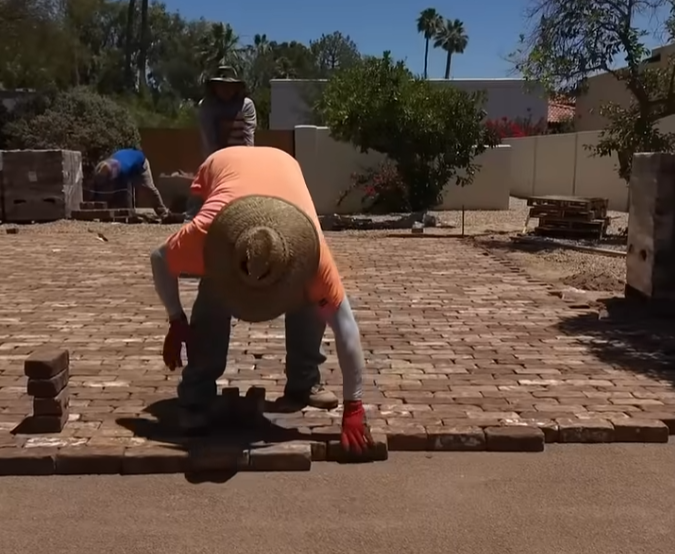
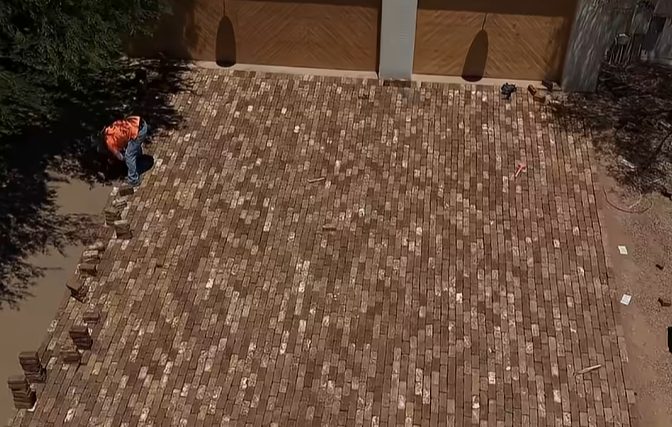
When we build driveways, we use smaller format pavers. That is not us being cheap or steering people away from a look they want. It is because we have seen what happens when you don't.
Smaller pavers spread the load. They handle heavy traffic. Delivery trucks, work trucks, daily in and out, none of that bothers them. The joints flex a little, the base does its job, and the surface stays flat and tight for years.
If a homeowner really wants the natural stone look near the driveway, there are ways to do it. Use the big stone for the walkway alongside the driveway, or for a landing pad at the front door, or for the patio out back. Use the right paver for the driveway itself. The two materials can live next to each other and tie the whole yard together without one of them failing.
What to ask before you sign anything
If somebody is quoting you a driveway in large format natural stone, ask them how they are dealing with vehicle load. Ask what the base is, ask how thick the stone is, ask what happens when a piece cracks and you need it replaced two years from now. If you don't get a clear answer, that is your answer.
There is nothing wrong with natural stone. We install a lot of it. It just has to go in the right place, at the right size, for the job it is actually being asked to do.
If you are thinking about a driveway or want to talk through what makes sense for your yard, reach out and we can walk through it together.
Curious what your project might cost?
Get an instant ballpark with our free estimator tool, no contact info required.