Why This Homeowner Chose Clay Brick Over Concrete
July 9, 2026
Most of our jobs in the Valley are concrete pavers. That is the default here. Concrete is local, it is consistent, and there is a color and shape for just about every style. So when a homeowner asks for clay brick, it is a different conversation.
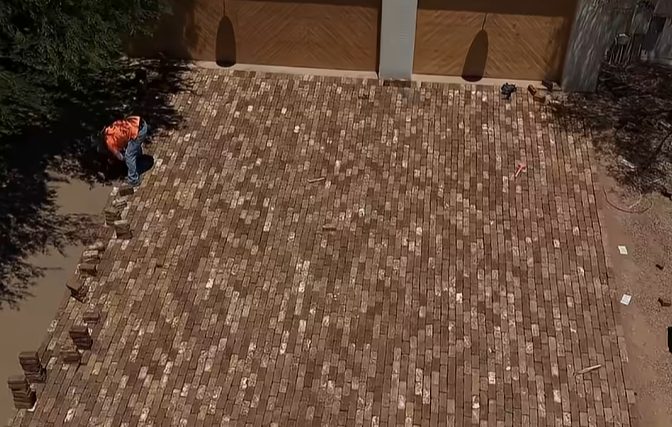
This one started with a walk down the street. The homeowner saw a neighbor''s driveway, liked the warm reds and the way the color had softened over the years, and asked if we could do the same thing. It took some digging, but we found it.
Where clay brick actually comes from
Concrete pavers are made close to home. There are plants right here in Arizona pumping them out by the pallet. Clay is different. The clay brick we are laying on this job comes all the way from northern California. One of the suppliers here in town brings it in.
That distance is part of why clay costs more. You are paying for the freight, and you are paying for a product that is fired in a kiln instead of pressed and cured. Clay is baked at high heat until the color is locked into the brick itself. It is not a surface color that can wear off. It is the brick.
Why a homeowner picks clay anyway
The honest answer is look and feel. Clay has a depth to it that concrete has a hard time matching. The colors are not printed on, they come from the earth and the fire. Reds, browns, oranges, a little bit of variation from brick to brick. Twenty years from now that color is still there.
There is also a texture to clay that people respond to. It feels older. It feels like something that belongs on a historic street, not something that came off a production line last month. For the right house, that matters.
The tradeoffs you should know about
Clay is not perfect. A few things to keep in mind before you commit.
Clay bricks are not always uniform. Sizes can be a hair off from one brick to the next. On the ground during install it can look a little bumpy and uneven, and that throws people off if they are watching the job in progress. Once the joints are sanded and the whole field settles in, it evens out and reads as one surface. You just have to trust the process while it is going in.
Selection is more limited. With concrete you have dozens of shapes and colors sitting at the yard. With clay you are picking from what the supplier can actually get on a truck. If you want a very specific look, you may wait longer to get material in.
Price is higher. Between the freight from California and the product itself, clay usually runs meaningfully more per square foot than a comparable concrete paver. For a driveway or a large patio, that adds up. It is worth asking for both numbers so you can see the gap.
Is it worth the extra money
For some people, yes. If you love the look, if you want a material that ages instead of fades, and if you plan to be in the house long enough to enjoy it, clay pays you back every time you pull in the driveway.
If your priority is the best value per square foot, or you want a specific modern color that only comes in concrete, we will tell you that too. There is no wrong answer. There is just the right answer for your house and your budget.
How we approach it on the job
When we do install clay, we plan for the size variation up front. We pull from multiple pallets as we lay so the color blends across the whole surface instead of ending up with a patch that is all one shade. We keep the base and the edge restraints just as tight as we would on a concrete job, because clay depends on that foundation to stay flat over the years.
The finished product is what sells it. Every clay job we have done, the homeowner walks out at the end and it clicks. The uneven look during install disappears and what is left is a surface with real character.
Curious what your project might cost?
Get an instant ballpark with our free estimator tool, no contact info required.