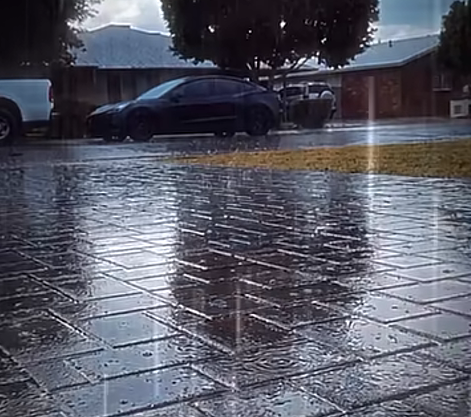
Why Do Scottsdale Paver Patios Still Need Serious Drainage?
October 19, 2026
This article is adapted from John Traynor's video above. The methods and opinions are John's, in his own words.
Read the video transcript
"People say it doesn't rain, and they don't have to worry about the water." You hear that a lot around here, and I get why. Most of the year our yards are bone dry. But on the backyard in this video, water was the first thing we had to solve, not the last.
That yard has water coming down off the roof, water coming off more than one patio, and walkways tying it all together. Every one of those surfaces sheds water when a monsoon cell parks over the house. We brought all of it together into one drain system that runs underneath the pavers and exits off the side of the property. You can't see any of it. That's the point.
Here's how I think about drainage on a paver patio in Scottsdale, why it matters even in the desert, and what to ask any contractor before they set the first paver.
Does a Scottsdale paver patio really need a drainage plan if it barely rains?
Yes, and I'd argue it needs one more than a patio back east does. We don't get rain often, but when we do, it comes all at once, and a yard that was never planned for water has nowhere to send it.
The mistake is thinking about rainfall over a whole year instead of rainfall in one afternoon. A monsoon storm can put a lot of water on your roof and patio in a short burst. Your hardscape doesn't care about the yearly average. It cares about the moment the gutters overflow and every hard surface in the backyard starts shedding water at the same time.
I said it in the video and I'll say it again. It can look beautiful, but if you come out and there's a flood the first day, that's not going to work. A patio that ponds at the back door, washes sand out of its joints or sends water toward the foundation has failed, no matter how good the pavers look in photos.
Where does the water actually come from in an Arizona backyard?
From more places than most people think: the roof, every patio and walkway, the slope behind the house, and sometimes the neighbor's yard. A real drainage plan accounts for all of it before anything gets built.
On this project you could follow the water from several directions. It came down off the roofline at the downspouts. It came off the patios, which are big flat surfaces that shed water fast. And it came across the walkways that connect those patios to each other. Each source on its own is manageable. All of them together, during the same storm, is a lot of water looking for the same low spot.
That's why I walk the whole property before I talk about pavers. Where are the downspouts? Which way does the lot fall? Is there a slope above the house that pushes water toward it? Is there a spot where the neighbor's runoff comes over the wall? If a contractor only looks at the square footage of the patio you want, they're missing most of the water that's going to land on it.
How do you drain several patios and walkways that all meet in one yard?
You bring every source of water together into one planned drain system and give it one clear way out. You don't solve each patio by itself and hope the pieces work together.
On this job, the water coming down from the roof and the water coming off the patios all come together into a drain system. That system hooks up underneath the pavers and exits on the far side of the property. One path in, one path out. The homeowner walks across a finished patio and a finished walkway, and underneath them the water from the whole backyard is moving to where it needs to go.
The reason to plan it as one system is that patios in the same yard affect each other. If the upper patio drains toward the walkway and the walkway drains toward the lower patio, and nobody planned where the lower patio sends it, all of that water ends up in one corner. Every surface can be sloped correctly on its own and the yard can still flood, because nobody looked at where all those slopes end up. This is the same thinking I wrote about in where water should drain on a paver driveway, just with more surfaces feeding into it.
Why run the drain under the pavers instead of around them?
Because that's where the water naturally wants to go, and because the only clean time to put it there is before the pavers go down. A buried line under the hardscape is invisible and protected, and nobody trips over it.
Running drainage around a patio usually means pipe or channels snaking through planters, along walls, or across the yard on the surface. It works, but it shows, and it often takes the long way around. Routing it underneath the pavers lets the water take the shortest path to the exit, and the patio surface stays clean and uninterrupted.
The catch is timing. Once the base is compacted and the pavers are set, adding a drain line means pulling pavers, digging out base and putting it all back. It's the same reason I tell people to plan hidden features like umbrella sleeves and hide lids before the install. Anything that lives under the pavers gets decided while the ground is open. If drainage comes up for the first time after the patio is finished, you're paying to do part of the job twice.
What goes wrong when drainage is an afterthought?
Water sits, and sitting water is what ruins a paver job: stained pavers, sand washed out of the joints, soft spots in the base and, eventually, pavers that sink or shift. The worst part is that it usually looks perfect until the first big storm.
Pavers are built to let some water down through the joints and into the base, and we put them over compacted ABC (aggregate base course) because it drains. I explained that in detail in where water goes under your pavers. But a good base can only handle the water that soaks through. It's not designed to absorb a whole roof's worth of runoff pouring onto one corner of a patio. When the volume is too much, water sits on top, runs where it shouldn't, and carries joint sand with it.
The other way this goes wrong is elevation. A step or a border set in the wrong spot turns into a dam. Water hits it, backs up and finds another way out, usually toward the house. On another job we added a full step that wasn't in the original design just so water had a clear path across a raised patio. You can read about that in consistent steps and how water decides where stairs go. Every elevation on a patio either helps water leave or helps it stay.
How do you know your contractor actually planned the drainage?
Ask them to show you, on your property, how all the water comes together and where it gets out. If they can't trace that path for you before they start, they haven't planned it.
The homeowner on this project has an engineering background, and that shaped the job in a good way. He wanted to see how all the water would come together and get out of there. That's exactly the right instinct, and you don't need to be an engineer to have it. You just need to ask the question and expect a real answer.
A good answer sounds specific: water from these downspouts goes here, this patio pitches toward this point, it all ties into a line under this walkway, and it exits over there. A bad answer sounds like "pavers drain, don't worry about it." While you're at it, ask what base material they use. If the answer is quarter minus or DG, that's a red flag for me, because those hold water instead of letting it move. I wrote more about what separates a good bid from a bad one in what to look for in a paver installation contractor in Scottsdale.
What happens when you call Stone Creations about a backyard with drainage concerns?
We come out, walk the whole yard with you and figure out where the water comes from and where it needs to go before we talk about pavers, patterns or colors. Drainage is part of the design from the first visit, not an add-on at the end.
On that first walk I'm looking at your downspouts, the way the lot falls, how your existing patios and walkways sit, and where water has been sitting after past storms. If you have photos of the yard after a monsoon, bring them. From there we lay out the patios, walkways or pool deck so the water has a clear path to an exit, and we'll explain that path to you in plain language. We do this with string lines and elevations, the way I described in why your paver job starts before the first paver.
Stone Creations has been installing pavers in Arizona for 25+ years. We're pavers-only, family-owned, licensed and insured under Arizona ROC #154361, and an award-winning ICPI Arizona Chapter contractor, and I serve on the board of the Southwest Hardscapes Association. You can read more about me, see our awards, or look through finished projects. For a ballpark number, start with our pricing page or the online estimator. When you're ready, call (480) 861-0699 or contact us. We're based in Scottsdale and work across Paradise Valley, Fountain Hills, Phoenix, Mesa, Gilbert and Chandler.
Scottsdale Patio Drainage Questions We Hear Most
How much does a paver patio with drainage cost in Scottsdale?
It depends on the size of the patio, the pavers you choose and how much water the yard has to move. The best place to start is our pricing page or the estimator, which give you a realistic range before anyone comes out. On the walkthrough we'll tell you if your yard needs drainage work beyond normal grading.
Don't pavers drain on their own?
Some water goes down through the joints into the ABC base, and that's part of why pavers handle Arizona weather well. But the base can only take what soaks through. Roof runoff and water from several patios at once need a planned path off the property, or they'll sit on top.
Should my downspouts dump onto the patio or tie into a drain?
If a downspout empties onto pavers, all that roof water lands in one spot during a storm, which is hard on joint sand and the base under it. On projects like the one in the video, we tie downspouts into a drain system under the pavers so the roof water leaves the yard without crossing the patio. Every house is different, so we look at where each downspout sits before deciding.
Can you add drainage to a patio that's already installed?
Often, yes. Pavers are individual units, so a section can be lifted, the base opened up for a drain line and the pavers reset. It's more work than planning it from the start, which is why I push to settle drainage before a new patio goes in.
Do patio drains need maintenance?
Any grate or inlet needs to stay clear. Monsoon storms bring dust, leaves and debris, and a clogged inlet can't take water. Check them before monsoon season and after big storms, and keep the joint sand topped off so the surface sheds water the way it was built to.
Does a walkway or pool deck need the same kind of planning?
Yes. A walkway or pool deck is just another hard surface shedding water, and it usually connects to other surfaces that do the same. We plan paver walkways, paver pool decks and paver patios as part of one yard, so the water from all of them ends up in the same planned exit. The same applies to paver driveways out front.
Which areas do you serve for paver patio projects?
We're based in Scottsdale and install paver patios, walkways, pool decks and driveways across the Valley, including Paradise Valley, Phoenix, Mesa, Gilbert, Chandler, Queen Creek, Peoria and Surprise. See all of our service areas for the full list.
How do I get started?
Call (480) 861-0699 or fill out our contact form, and tell us about any spots where water has been a problem. We'll set up a time to walk the property and show you where the water is going to go before we pick up a tool.
Curious what your project might cost?
Get an instant ballpark with our free estimator tool, no contact info required.