Why Is Uneven Pool Coping a Big Problem for Scottsdale Pool Decks?
October 19, 2026
This article is adapted from John Traynor's video above. The methods and opinions are John's, in his own words.
Read the video transcript
I was standing on a pool deck in the desert foothills not long ago, looking at a pool edge that had been worked on before we ever showed up. Here is how I described it on camera: "They overlaid some of the bond beam and they didn't overlay others of the bond beam." The result was "a two or three-inch difference in coping here and coping there, which didn't work."
That is the whole problem in one sentence. Pool coping can only be as level and consistent as the surface it sits on. If somebody builds up part of that surface and leaves the rest alone, the coping is going to show it, and no amount of nice stone on top will hide it.
So what did we do? "By being able to rip everything out, we were then able to make it consistent." In 25+ years of building paver pool decks around Scottsdale and the Valley, I have learned that this is the fix that actually lasts. Here is why, and what you should check on your own pool before anyone sells you a quick patch.
Why is uneven pool coping such a big problem?
Uneven coping is a big problem because it is never just a cosmetic issue. It is a sign that the surface underneath the coping is inconsistent, and the only real fix is to make that surface consistent before the coping goes back on.
The coping is the stone that runs around the very edge of your pool. It is the first thing your eye lands on when you walk outside, and it is the line everything else on the deck relates to. When one run of coping sits two or three inches higher than the next, you see it from across the yard.
Think about where that jump sits, too. It is right at the water's edge, where people walk barefoot and wet, where kids run, and where you step in and out of the pool. A two or three-inch lip in that spot is a trip point. On a project where the coping is supposed to be the smoothest, most comfortable part of the deck, an uneven edge is the opposite of what you are paying for.
What is a bond beam, and why does the coping depend on it?
The bond beam is the thick concrete edge that runs around the top of your pool, and the coping sits on top of it. If the bond beam is not at one consistent height all the way around, the coping cannot be either.
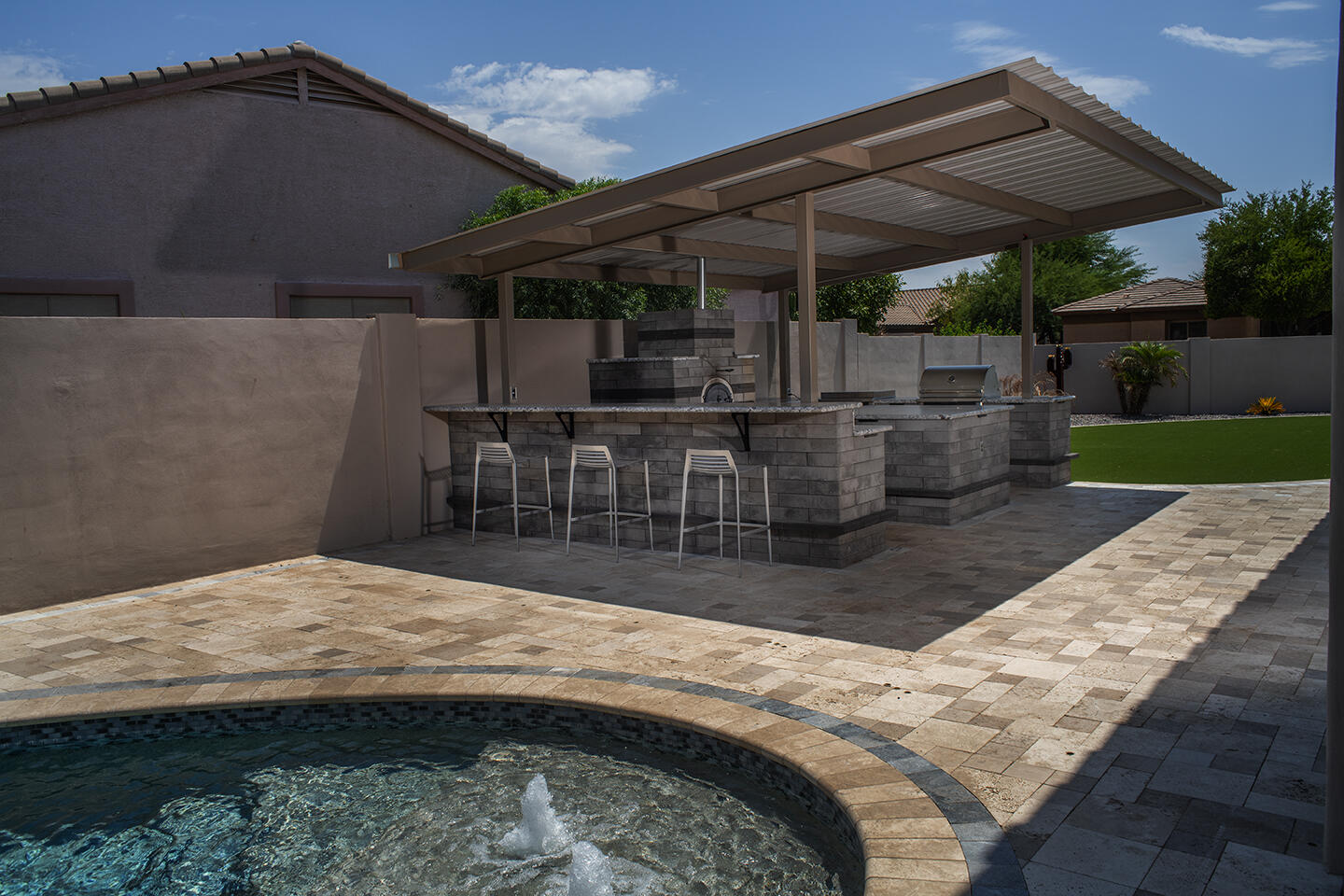
As I put it in the video, "The bond beam is what goes around the edge of the pool." It is the structural top of the pool shell. Everything at the edge of your pool, the coping and the transition to your deck, gets built off that beam. On our earlier travertine pool deck in Glendale, the bullnose coping is the rounded edge piece that sits right on top of the bond beam. That relationship is the same on every pool, whether you are using travertine, concrete pavers or natural stone.
Here is the part most homeowners never hear: the coping is only the finish. What it rests on decides whether it ends up straight. If one section of the beam has been built up and the next section has not, you have created two different starting heights. A good installer can set coping perfectly on either one. What nobody can do is make coping look consistent when the surface underneath has a step built into it.
How does a partial overlay leave a 2 or 3 inch difference in coping?
A partial overlay leaves a 2 or 3 inch difference because it raises the surface in some spots and not others. Wherever the overlay stops, the coping height jumps.
An overlay means building over what is already there instead of tearing it out. Done right, across the whole area, an overlay can be a smart way to go. On the pool I talked about in the video, the problem was that "they overlaid some of the bond beam and they didn't overlay others of the bond beam." So part of the edge got raised by the thickness of the overlay, and part of it stayed at the original height. When the coping went on, it followed both heights.
Why does this happen? Usually it is a shortcut. Maybe one section was easy to build up and another had a waterfall, a spa or a step in the way. Maybe someone was trying to save a day of labor or a few pieces of stone. The homeowner ends up paying for it later, because now you have a pool edge that "didn't work," and the only clean way to fix it is to undo the shortcut.
Can you shim or patch uneven coping instead of tearing it out?
No. If the surface under your coping is inconsistent, shimming or patching just hides the problem for a while. Rip it out and make the surface consistent, then set new coping on it.
I know tear-out sounds like the expensive answer. But look at what a patch really does. You are adding material on top of material, trying to fake one consistent height on a surface that has two. That is how you end up with coping that rocks, cracks or pulls loose down the road, and then you are paying to fix the fix.
On this job, ripping everything out is what let us start over with one consistent surface all the way around the pool. Once everything is out, you can see what is really underneath, set every section of the edge to the same height and build the coping on something solid and even. It is the same thinking behind the fragmented decks and elevations we replace with one continuous surface. Consistent elevations are not a luxury on a pool deck. They are the job.
How should the surface under new pool coping be prepared?
Before any new coping goes down, the whole edge should be brought to one consistent height, checked with string lines, and planned so water drains away from the pool and the house.
Consistency does not happen by eye. On every job we lay out string lines and grading before the first paver goes down, and the pool edge gets the same treatment. Every section of the bond beam and the surface that meets it has to land at the same height. If any section has been built up in the past, you either take it out or bring everything else to match. What you never do is leave two heights and hope the coping covers it.
Prep also means planning where the water goes. A pool deck needs slope away from the house and away from the pool coping, so you are not trapping water against the structure or sending deck runoff into the pool. On our patios and pool decks we often build in drainage gaps that work like a hidden gutter, and we always ask where the water goes under the pavers. Out in the field of the deck, we build on ABC (aggregate base course) that is wet down and compacted in lifts. If a contractor tells you they are putting quarter minus or DG under your pavers as the base, that is a red flag.
What should you check and ask before anyone touches your coping?
Check your coping for steps where one section meets the next, and ask any contractor exactly how they will make the surface underneath consistent. If they cannot answer that, they should not be working on your pool.
You can do a quick check yourself. Walk the full edge of your pool and look at where one section of coping meets the next. Is there a step? Lay a long straightedge or a level across those seams. Look for places where the coping was obviously built up, like a thicker edge or a different mortar line under one section. Look for spots where water sits on the deck after you hose it down. A partial overlay usually shows up as a clean jump right where the old work stops.
Then ask the questions that separate a pool deck specialist from a guy with a truck:
- "How are you going to make the bond beam and the surface under the coping consistent all the way around?"
- "Are you overlaying or tearing out, and why?" If they are overlaying, ask whether they are doing the whole edge or just part of it.
- "Where is the water going to drain?" If they shrug, walk away.
- "What are you putting under the pavers?"
For more on vetting an installer, read what to look for in a paver installation contractor in Scottsdale.
What happens when you call Stone Creations about uneven pool coping?
When you call us about uneven coping, we come out, look at your pool edge and tell you honestly whether the surface underneath is consistent. If it is not, we will tell you that the right fix is to take it out and rebuild it, not patch it.
I am John Traynor, owner and founder of Stone Creations. We are a family-owned, pavers-only company, and paver pool decks are one of the things we do best, along with driveways and patios. We are licensed under Arizona ROC #154361, and we are an award-winning ICPI Arizona Chapter contractor. I also sit on the board of the Southwest Hardscapes Association. None of that matters if the coping around your pool is two inches off, so on a walkthrough we look at the edge first and tell you straight what it needs.
Call us at (480) 861-0699 or contact us online to set up a visit. If you want a ballpark first, the pricing page and our instant estimator are a good start, and you can read more about me and how we work. See our paver pool deck work and a finished backyard pool deck with bullnose coping. We are based in Scottsdale and build pool decks across Paradise Valley, Phoenix, Mesa, Gilbert, Chandler and Queen Creek.
Scottsdale Pool Coping and Bond Beam Questions We Hear Most
How much does it cost to redo uneven pool coping in Scottsdale?
It depends on how much of the edge has to come out, the size of your pool deck and the stone you choose. The honest way to find out is to have someone look at the bond beam and the surface under the coping. Our pricing page and instant estimator give you a starting point for a paver pool deck before we come out.
Can pavers go over my existing pool deck in Scottsdale?
Sometimes, yes. An overlay done right, over the whole area, can be a cost-effective way to get a new paver or travertine pool deck, like our Glendale travertine overlay. What does not work is overlaying part of the bond beam and not the rest, because that leaves you with coping at two different heights.
Is uneven pool coping a safety issue?
It can be. A two or three-inch lip at the edge of the pool is a trip point in the one spot where people are barefoot, wet and not watching their feet. If your coping has a jump in it, get it looked at before someone catches a toe on it.
What kind of coping works best with a paver pool deck?
Bullnose coping is a popular choice because the rounded edge is smooth and easy on bare feet, and it gives the pool a clean, finished line. You can see it on our backyard pool deck with bullnose coping. Whatever style you pick, it has to sit on a consistent surface or it will not look right.
How does Arizona heat and monsoon rain affect pool coping and pavers?
Travertine stays cooler underfoot than concrete, which matters around a Scottsdale pool in July. Rain is the bigger risk for the deck itself. If water is not sloped away from the house and the pool coping, one bad monsoon storm can cause real damage, which is why we plan drainage first.
Does Stone Creations only do pool decks?
No. We are pavers-only, so we stay focused on paver work: paver pool decks, paver driveways, paver patios, paver walkways and travertine installation. We do not do turf, irrigation or general landscaping.
How do I get started on fixing my pool coping in Scottsdale?
Call (480) 861-0699 or reach out on our contact page. We will come take a look at your pool edge, tell you what is going on underneath the coping and walk you through the right fix for your backyard.
Curious what your project might cost?
Get an instant ballpark with our free estimator tool, no contact info required.