
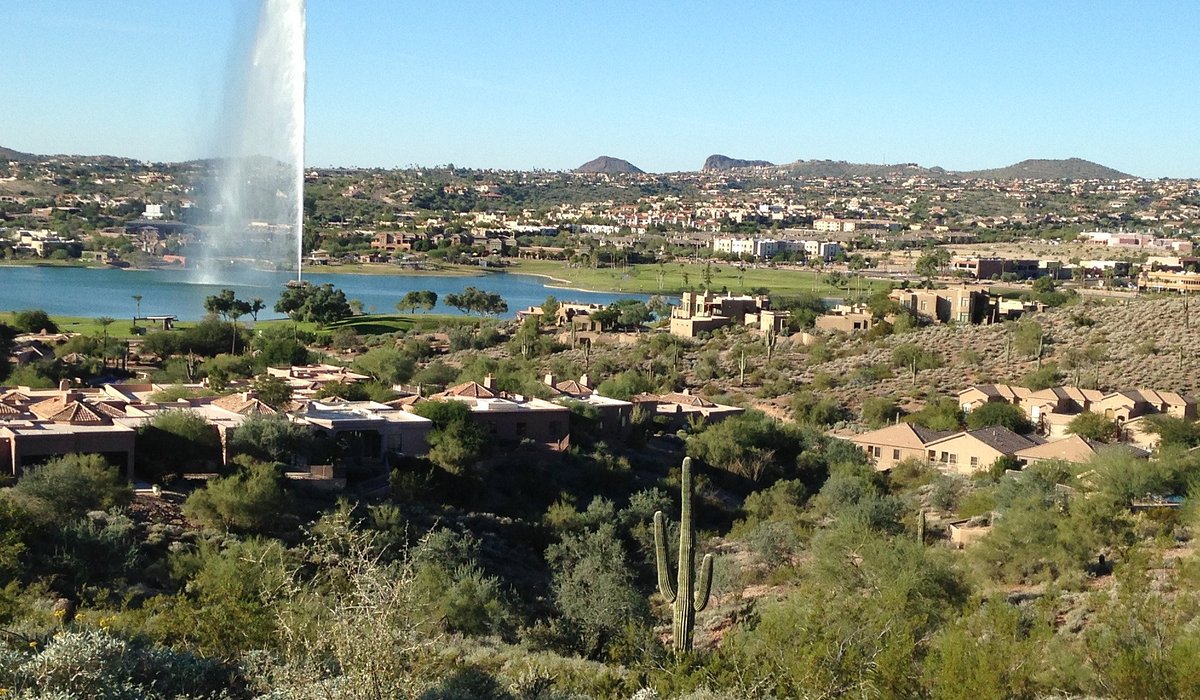
Plenty of Fountain Hills homes sit above or below the street, so the driveway climbs or drops to the garage. The ground under it is rock, granite and caliche, often under a layer of DG. That changes how water moves and where the pavers take stress. A good Fountain Hills driveway starts with the grade and the drainage, and the pattern comes after.
How much a Fountain Hills paver driveway costs
A typical two-car paver driveway of about 550 to 900 square feet runs $5,000 to $10,000 installed in standard concrete pavers, and about $5,500 to $10,800 in tumbled pavers. (Side note: standard pavers come to about $9 to $11 per square foot.)
A few things shift the total on a Fountain Hills drive:
- Tear-out. Removing an old concrete driveway adds about $1,400 to $2,700.
- Borders. A contrasting-color border adds about $300 to $450. A different border paver adds about $550 to $900.
- Pattern. This one doesn't. Basketweave, herringbone, random and running bond are priced identically.
- Length. A drive that runs a long way up a hillside is bigger than a typical two-car pad, and it's priced by the measured area.
Here's a worked example. A 700 square foot sloped driveway in standard pavers, replacing cracked concrete, with a contrasting border. The pavers land around $6,300 to $7,700. Add $1,400 to $2,700 for tear-out and $300 to $450 for the border, and you're at about $8,000 to $10,850. The exact price follows a site measurement. Get a ballpark now from the estimator.
Sloped drives and monsoon water
On a sloped drive, water runs fast and collects at the bottom, which is usually right in front of the garage door or at the street. A monsoon storm puts a lot of water on a hillside in a hurry. Before we dig, we work out where that water should go and set the grade so it gets there: off the surface and away from the garage. More on where driveway water should end up.
Slope also pushes on the pavers. Climbing and braking tires shove the surface downhill, so solid edge restraint along both sides matters more here than on a flat lot. Herringbone is a common choice on slopes because the pavers lock together in more directions, and it costs the same as any other pattern.
Building on rock and DG
Fountain Hills sits against the McDowell Mountains, and the ground shows it. Digs hit granite, boulders and caliche, usually under a layer of decomposed granite. Rock makes the excavation harder, but it isn't the real risk. The real risk is a base built from whatever is already on site. DG and quarter-minus are fine as yard cover and wrong as a driveway base.
What we bring in instead is ABC (aggregate base course), 4 inches of it under every driveway, watered and compacted in lifts. Then the bedding sand gets screeded, edge restraint goes in, the pavers are laid, and joint sand is swept into them before the final compaction. The base mistakes that sink driveways early, and what a solid base looks like.
Widening the drive on a hillside lot
Sometimes the real goal is more room: a wider drive, a guest parking pad, a place to turn around. On a hillside lot, the plat comes first. If it shows a recorded hillside protection easement, that ground stays untouched unless the Town Council approves grading or construction there. FireRock and Eagle Mountain, both gated, also have their own design review, and we line up both answers before the job is scheduled.
Paver Driveways in Fountain Hills: Frequently Asked Questions
How much does a Fountain Hills paver driveway usually cost?
A typical two-car driveway of 550 to 900 square feet runs $5,000 to $10,000 in standard concrete pavers, or about $5,500 to $10,800 tumbled. Removing an old concrete driveway adds about $1,400 to $2,700, and a border adds a few hundred dollars.
Can you put pavers on a steep driveway?
Yes. A steep drive needs more attention to drainage and edge restraint, and the base has to be solid. We map out the water's path before any digging starts.
Will pavers creep downhill on a sloped drive?
Not with the right base and edges. Edge restraint holds the sides, joint sand locks the pavers together, and an interlocking pattern like herringbone resists the push from tires.
My lot is mostly rock. Can you still build a driveway on it?
Yes. Rock makes the dig harder, but the base stays the same: 4 inches of ABC, soaked and compacted in lifts. We look at the site before we price it.
Can I widen my driveway on a hillside lot?
Often. The catch is a hillside protection easement: if your plat shows one, grading or building inside it needs Town Council approval. In FireRock or Eagle Mountain, the HOA design review has a say too.