
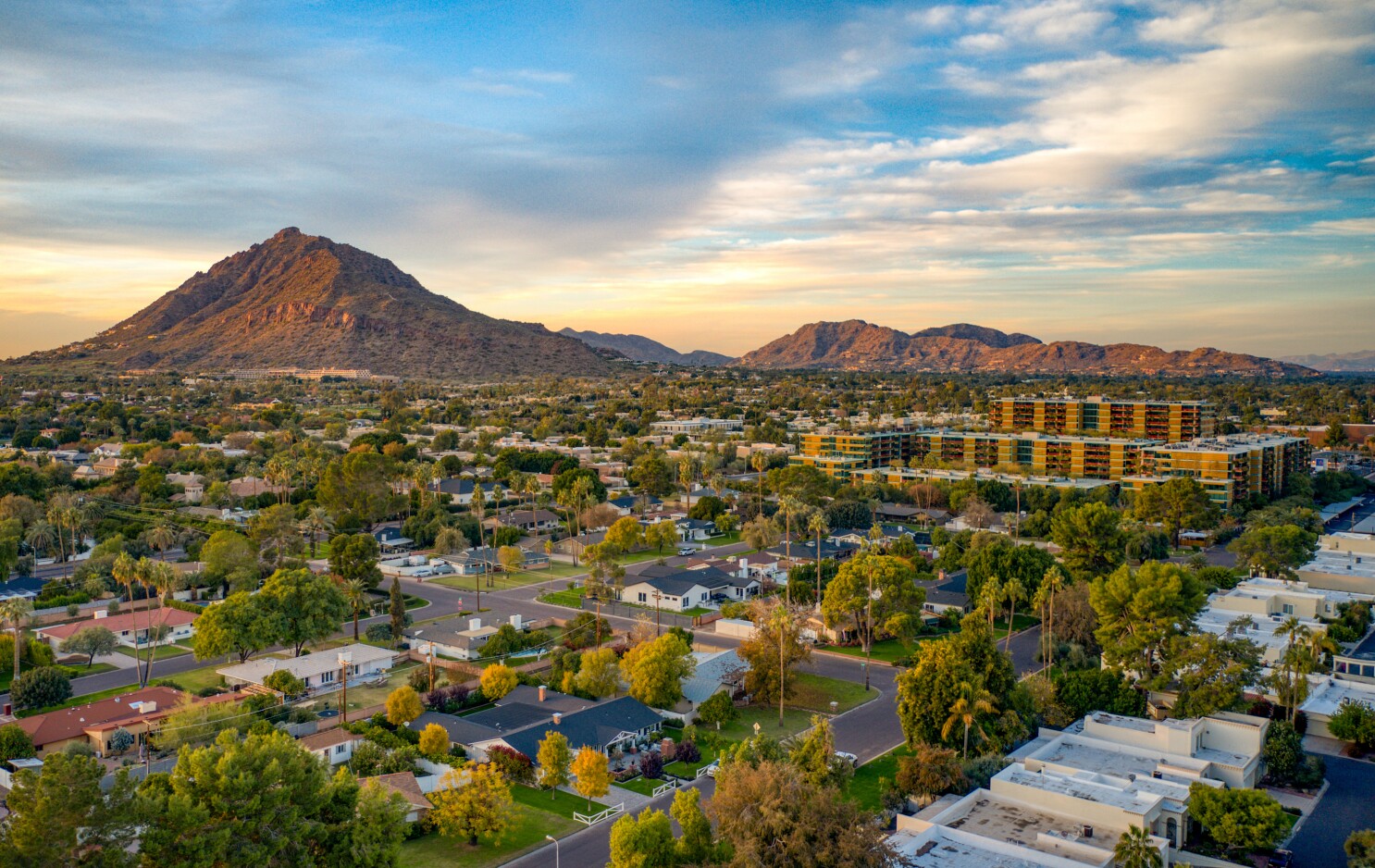
Paradise Valley patios are usually built around a view. On an acre lot with Camelback or Mummy Mountain behind the house, the patio is where you sit and look at the mountain, and it often connects to a pool deck, a fire pit or an outdoor kitchen. Material is the big decision here, and on hillside lots, so is where the Town lets you build.
Paver patio costs on a Paradise Valley lot
At the usual patio size of 300 to 600 square feet, installed totals look like this:
- Concrete pavers: $2,500 to $6,600
- Large format pavers: $3,300 to $7,800
- Artistic pavers: $4,200 to $9,600
- Natural stone or travertine: $4,500 to $10,800
- Porcelain: $5,700 to $13,200
Breaking out an old concrete patio adds about $750 to $1,800, and a backyard that's hard to reach adds about $150 to $300. The minimum job is $800. On a big lot, patios often run past 600 square feet, and those price above these ranges.
Here's a worked example. A 600 square foot travertine patio behind a remodeled house, replacing the original concrete slab. That's the big end of the travertine range, about $9,000 to $10,800. Add $750 to $1,800 to break out the old slab, and you're at about $9,750 to $12,600 all in. (Side note: travertine runs roughly $15 to $18 per square foot at typical patio sizes.) Once we measure, you get the exact figure. Get your own ballpark from the estimator.
Patios on Camelback and Mummy Mountain lots
On a hillside lot, the patio usually sits on the downhill side of the house, facing out. The ground falls away, so the outer edge may need steps or a raised section, and every step has to be the same height or people trip. Getting steps and elevations to line up.
These lots also fall under the Town's hillside rules, which kick in where the natural grade is 10 percent or more. The Town's Hillside Building Committee reviews grading and drainage, and the steeper the lot, the less of it can be disturbed. Hillside review also covers exterior lighting, so plan any patio lights early. A patio that pushes out into the slope gets designed with all of that in mind.
Flat acre lots and older homes
Off the hills, much of Paradise Valley is flat acre lots with mature yards. When an older house gets remodeled, the original patio slab usually comes out with it, and the new patio gets laid out for how the family actually uses the yard.
Flat is its own problem. Caliche sits under much of the Valley and doesn't drain, so a patio built dead flat will hold water. We slope every patio slightly away from the house and plan where that water exits before we lay anything. Then the layers go in: the compacted base, bedding sand screeded smooth, edge restraint around the outside, and joint sand swept in once the pavers are down. What happens to water under a patio.
Picking the material
Concrete pavers cost the least and are the most forgiving. Large format pavers give a cleaner, modern look with fewer joints. Travertine and natural stone have a softer, natural feel, and lighter colors stay cooler underfoot. Porcelain gives a crisp, contemporary look and costs the most. If the patio meets a pool deck, use the same material or plan a border between them so the backyard reads as one job. For evening use, this piece on resort-style patio lighting and seating is worth a read. On a hillside lot or behind a gate, we get the Town's and the community's approvals lined up before we book the job.
Paver Patios in Paradise Valley: Frequently Asked Questions
What are typical paver patio costs on a Paradise Valley lot?
A 300 to 600 square foot patio runs $2,500 to $6,600 in concrete pavers, $4,500 to $10,800 in travertine or natural stone, and $5,700 to $13,200 in porcelain. Bigger patios cost more, and removing an old slab adds about $750 to $1,800.
Can you build a patio on a hillside lot?
Yes, with steps or a raised edge where the ground drops. Where the natural slope is at least 10 percent, the Town's hillside rules limit how much ground can be disturbed, so we confirm that before we design.
Is travertine or porcelain better for a Paradise Valley patio?
Travertine has a softer, natural look and feel. Porcelain is crisper and more uniform, and it costs more. It comes down to the house and the budget, and we'll bring both out to look at next to your house.
My patio will connect to the pool deck. Should they match?
Usually. The same material, or a planned border between them, keeps the backyard from looking like two separate jobs. We lay out both together even if you build them at different times.
How do you keep water from sitting on a patio on a flat lot?
We slope the patio slightly away from the house and plan where the water exits before we lay anything. Caliche doesn't drain, so the water has to leave across the surface instead of soaking in.