
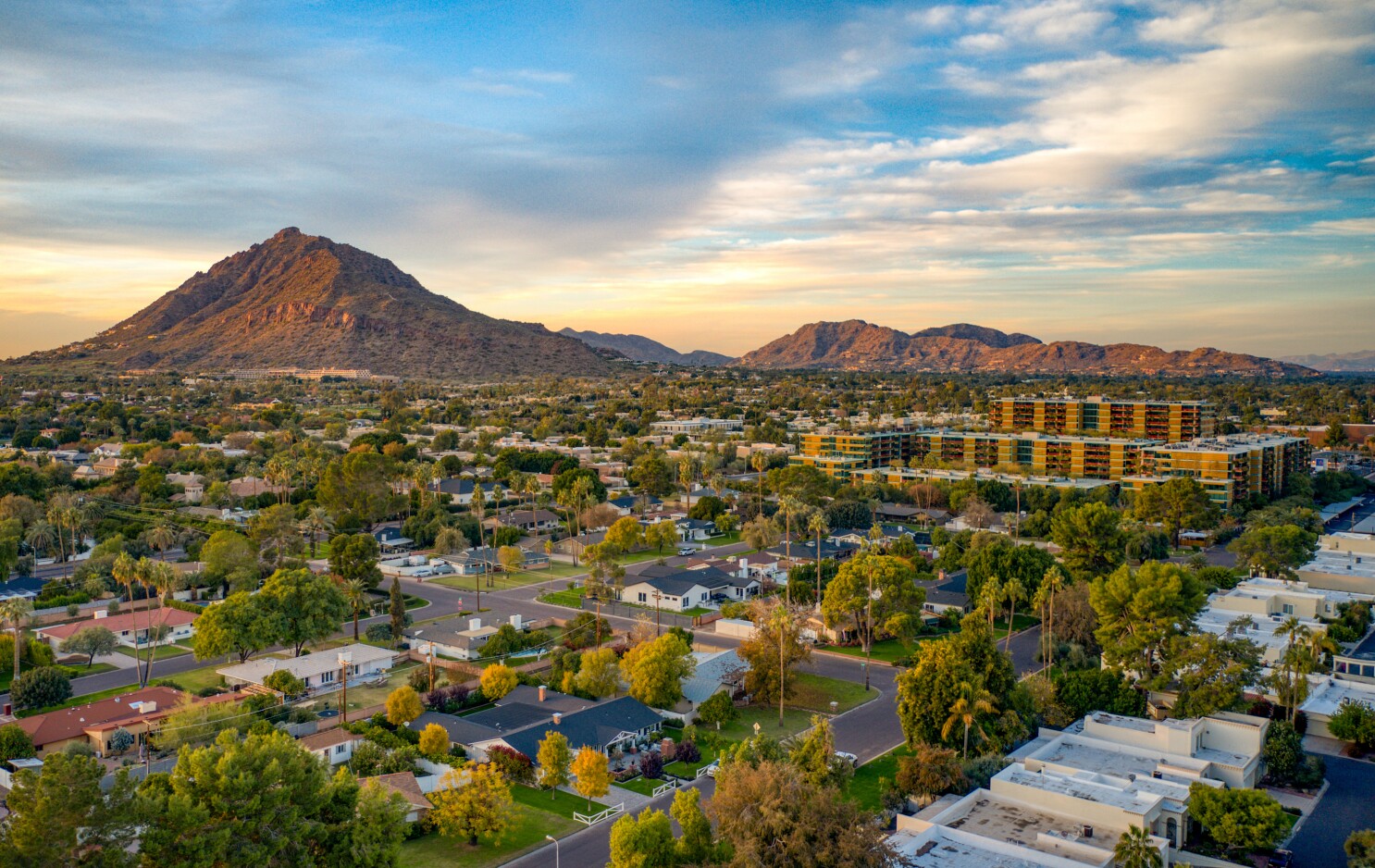
Paradise Valley driveways are rarely a short slab to a two-car garage. On an acre lot, the drive runs long, sometimes passes through a gate, and opens into a motor court in front of a multi-car garage. Some climb toward hillside homes on Camelback or Mummy Mountain. That's more paver, more weight and more water to move, so the plan matters as much as the pattern.
Paver driveway costs on a Paradise Valley lot
A typical two-car paver driveway of about 550 to 900 square feet runs $5,000 to $10,000 installed in standard concrete pavers. In tumbled pavers, figure about $5,500 to $10,800. (Side note: standard pavers work out to about $9 to $11 per square foot.)
Where the total goes from there:
- Size. Long approaches and motor courts often run well past 900 square feet, so they price above the typical range. We measure and quote the real area.
- Tear-out. Removing an old concrete driveway adds about $1,400 to $2,700 on a typical driveway.
- Borders and banding. A contrasting-color border adds about $300 to $450. A different border paver adds about $550 to $900.
- Pattern. Nothing changes here. Running bond, herringbone, random and basketweave come in at the same price.
Here's a worked example. A 900 square foot drive in tumbled pavers, replacing old concrete, with a border in a different paver. The pavers land at the top of the tumbled range, about $9,000 to $10,800. Add $1,400 to $2,700 for tear-out and $550 to $900 for the border, and you're at about $10,950 to $14,400. Your own number comes from a site measurement. For a ballpark now, use the estimator or the pricing guide.
Motor courts on acre lots
A motor court is a parking and turning area, not just a path to the garage. Cars turn on it, guests and service trucks park on it, and it's the first thing anyone sees when they pull in. Turning tires twist the surface, so the base and the edges do the real work.
That work starts below grade. Our driveways and motor courts get 4 inches of ABC (aggregate base course), soaked with water and compacted in lifts. Bedding sand is screeded over it and edge restraint goes in along the borders. After the pavers are laid, joint sand gets swept into them and the surface gets one more compaction. If a bid puts DG or quarter-minus under a motor court, take that as a warning sign. What a driveway base should look like.
A big flat surface also has to shed a lot of water. We set the grade so the court drains away from the house and the garage, toward a planned outlet, before any paving starts. How we decide where driveway water drains.
Matching the drive to the house
Motor courts are where borders, banding and inlays tie the drive to the architecture. When a house has travertine or natural stone out back, owners often want the driveway to match. Be careful there. Not every stone is made for car traffic, and the wrong one will chip or crack under turning tires. The natural stone driveway mistake. A tumbled or stone-look concrete paver can carry the same look and handle the weight.
Hillside drives and washes
On hillside lots near Camelback and Mummy Mountain, the drive often climbs to the house. Water picks up speed on a slope and lands at the bottom, usually at the garage apron or the street. Once the natural slope hits 10 percent, the Town's hillside rules apply, and grading a drive on that kind of lot goes through the Hillside Building Committee.
The flatter lots have their own problems. Natural washes cross many properties, the Town's grading rules protect them, and caliche under the drive doesn't drain. So we plan the grade first and keep water moving across and off the pavers, not into the base. Some neighborhoods also have their own architectural review on top of the Town's, and we get that settled before the job is booked.
Paver Driveways in Paradise Valley: Frequently Asked Questions
What are typical paver driveway costs on a Paradise Valley lot?
A typical two-car driveway of 550 to 900 square feet runs $5,000 to $10,000 in standard concrete pavers, or about $5,500 to $10,800 tumbled. Motor courts and long drives price above that because they're bigger. Removing old concrete adds about $1,400 to $2,700 on a typical driveway.
Can a paver motor court handle trucks and turning cars?
Yes, if the base is right. The court sits on 4 inches of ABC that's wet down and compacted in lifts, and the edge restraint is solid enough that turning tires don't push pavers out at the sides.
Can I use travertine on my driveway to match my pool deck?
Sometimes. Some stone holds up to car traffic and some doesn't, so we go over the product with you before you commit. A tumbled or stone-look concrete paver is another way to tie the drive to the house.
My driveway climbs a hill to the house. What changes?
Water moves faster and collects at the bottom, so the drainage plan comes first. If your lot's natural slope is 10 percent or steeper, grading also falls under the Town's hillside rules.
Do I need Town or HOA approval for a new driveway in Paradise Valley?
Possibly. On a hillside lot, the Town's Hillside Building Committee looks at grading and drainage, and a gated community may want its own architectural sign-off. We confirm both for your property before booking the work.